 Elanorya
Bracelet photography
Bracelet photos where the front stays the front
A ring is held in place by the finger it sits on. A bracelet is not held by anything — it hangs on a wrist and turns. Which face of it a camera sees is a decision, and if you do not make it, gravity will.
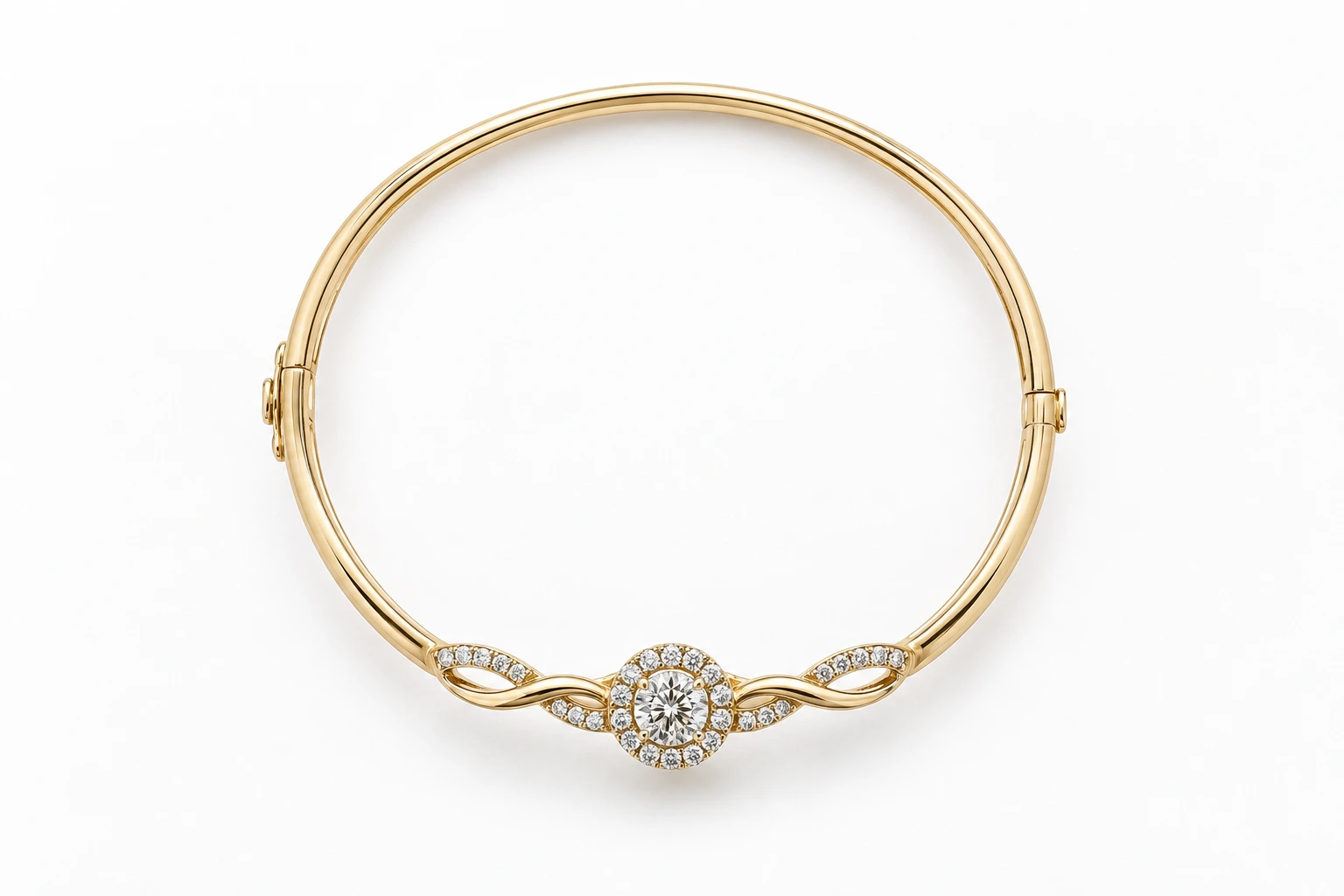
Why the front might not be the front
The wrist is a cylinder and the bracelet is loose on it. All three of these are the same bracelet — only the rotation differs.
1 · Face toward the camera
What you want, and what a deliberate reference photograph plus a well-chosen wrist angle makes likely. This is the only rotation where close framing pays for itself.
2 · Turned to the side
The most common real outcome, and often acceptable — a bracelet seen at an angle still reads as a bracelet. It stops being acceptable when the side is where the clasp lives.
3 · Turned underneath
The face is against the inside of the wrist and the camera sees a plain band. Nothing about the product is visible, and no choice of framing recovers it.
What goes wrong, and what to do about it
Almost all of these are settled by the reference photograph and the base photo.
The bangle reads as an oval
Shoot closer to perpendicular. A circle photographed steeply is an ellipse, and the ellipse is what carries forward.
Slack disappears from a chain
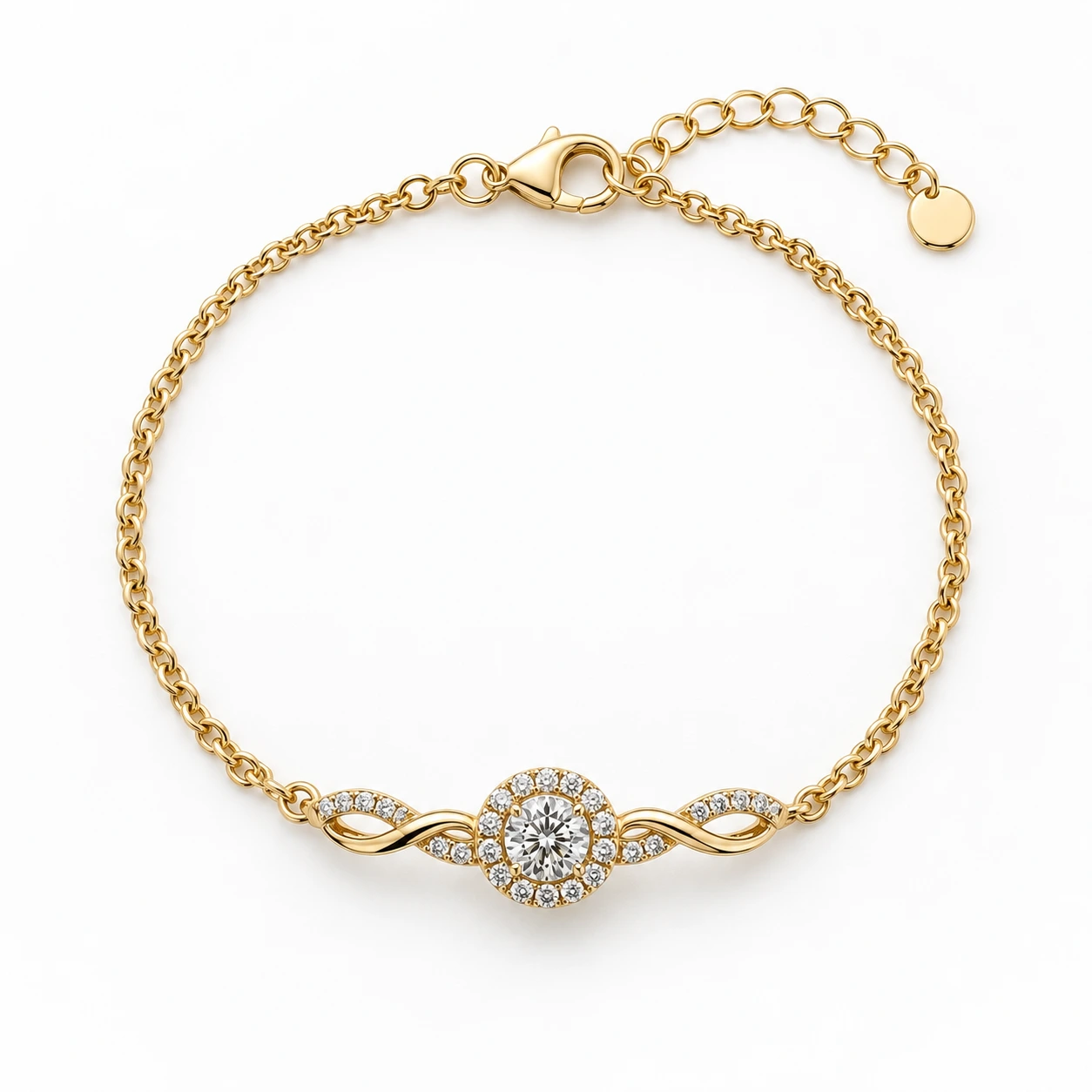
Photograph a chain bracelet with its natural droop visible. A chain laid taut looks rigid, and rigid is a different product.
Charms bunch on one side
Space them by hand in the reference. This is a two-minute arrangement that decides how the piece looks in every generated frame.
The clasp ends up centered and featured
On a bracelet the clasp is also the fit mechanism, and it rotates to the underside as the piece settles. If your reference photograph puts it front and centre, the reference is telling the model that is where it belongs.
The piece looks too large or too small for the arm
Choose a base photo with a wrist of ordinary proportion. This is one of the few categories where the body part itself carries the size claim.
Stacked pieces merge into one
Photograph stacks only when the stack is what you sell. Otherwise, one product per reference — the instruction preserves what it is given, including ambiguity.
Source and result
Empty until real generations exist. A diagram explains geometry; it is not output.
Questions
Can I get a close-up of a bracelet?
Bracelets and rings are the only two categories where the close-framing filter is offered — but it filters the model catalogue rather than zooming the output. It narrows you to base photos shot tight on the wrist, which only helps if the face you want is the one turned toward the camera.
Why does the bracelet look rotated?
Because a bracelet is loose on a wrist and a wrist is round. The instruction places it around the wrist; where its decorative face ends up depends on your reference and on the angle of the wrist in the base photo.
Will it show the clasp?
Usually not — it ends up under the wrist, which is also where it sits in real wear. That matters more here than elsewhere: on a bracelet the clasp determines fit, so if it is adjustable or extendable, say so in the listing rather than hoping a photograph shows it.
Can I photograph a stack of bracelets?
You can, and the result will show a stack — the model is instructed to preserve item count. That is only what you want if the stack is the product. For single pieces, one bracelet per reference photograph.