 Elanorya
Earring photography
Earring photos that keep the pair a pair
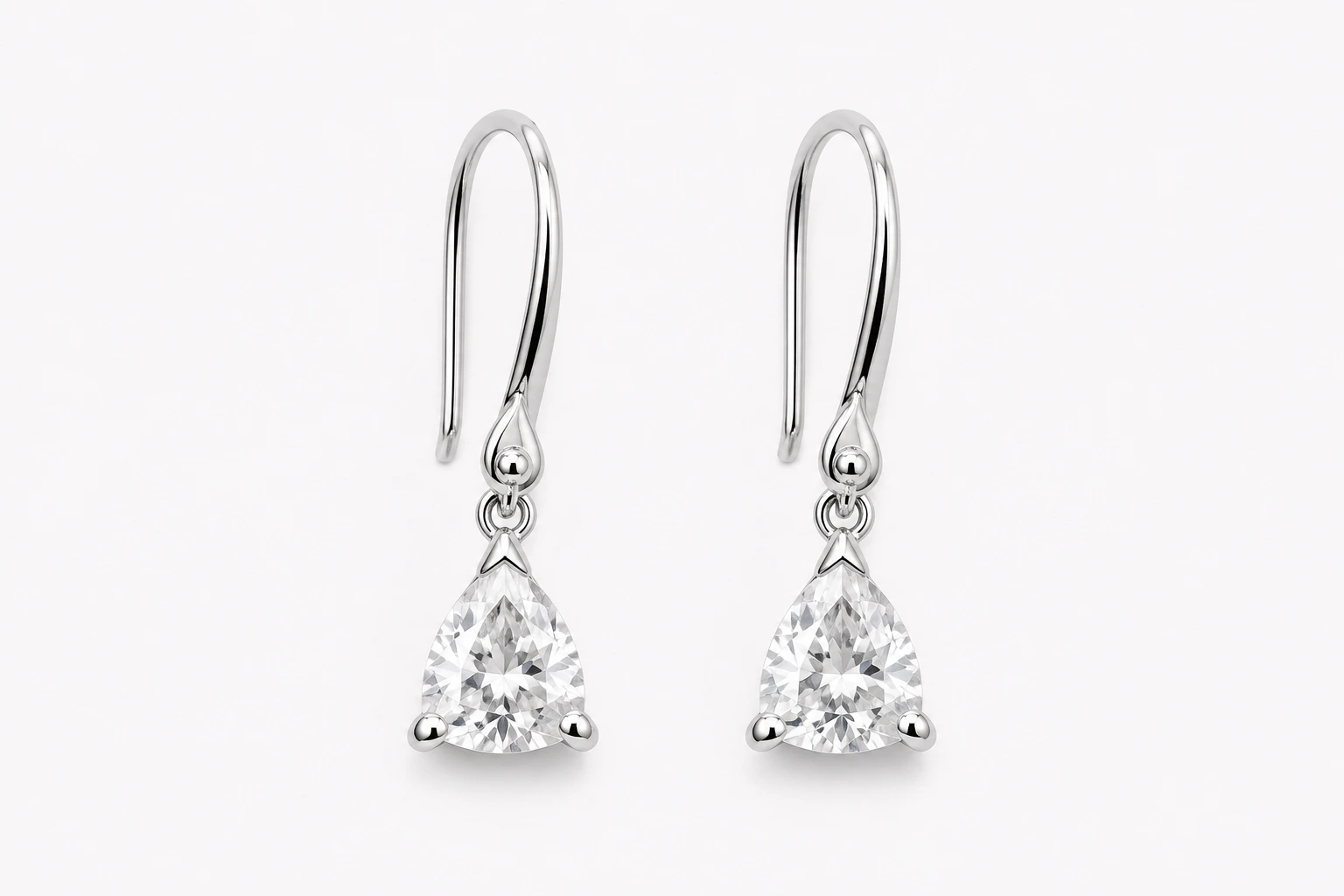
Earrings are the only jewelry category that is normally two objects. In a three-quarter or profile portrait only one lobe is visible, so a pair has to survive being half hidden — without the hidden half being invented, and without a front-facing portrait turning one earring into two.
Why a pair appears once
This is the geometry that makes earrings different. It is not a limitation of the tool — it is what a photograph of a head is.
1 · A pair, correctly shown once
The reference was two physical objects; the portrait shows one lobe, so one earring is visible. Photograph both pieces anyway — a pair reference is what tells the model a pair exists.
2 · Correct output
One earring is visible on the lobe that faces the camera. The pair has not become a single; it is simply half occluded, exactly as it would be in a real photograph.
3 · Faulty output
A second earring appears on an ear the camera cannot properly see, or the first is mirrored across the head. Both are the failure the instruction's mirror-and-duplicate clause exists to prevent, and both are obvious once you look for them.
What goes wrong, and what to do about it
Most of these are decided before you spend a credit — by which photo you choose and which ear it shows.
A single is read as a pair
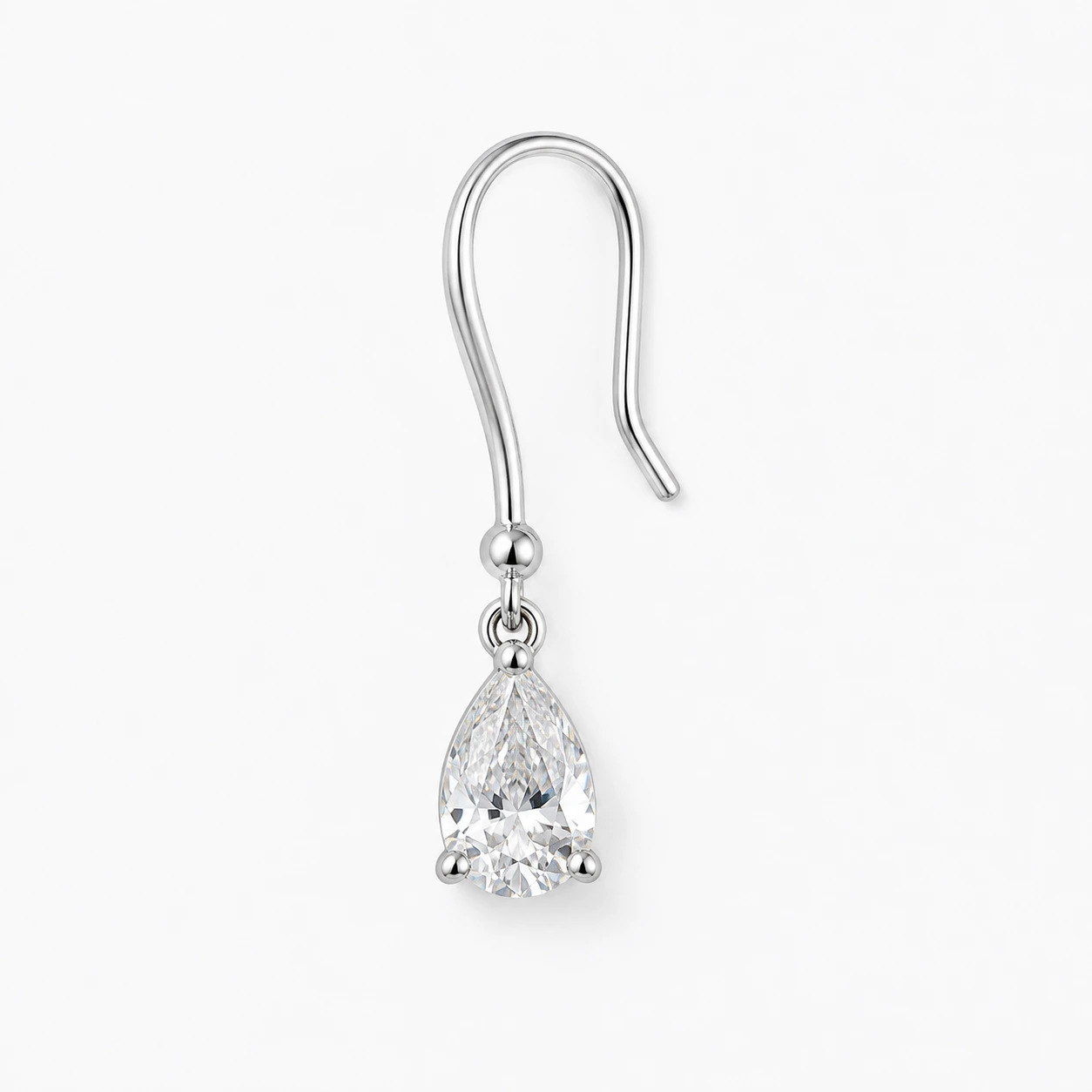
If you sell singles — ear cuffs, one-off studs, mismatched sets — photograph exactly one item, alone, with nothing beside it. A reference showing two objects is the strongest signal that two exist.
The second earring is invented
Choose a portrait where the far ear is genuinely hidden by hair or angle. An ambiguously visible second lobe is an invitation to fill it.
The lobe is not actually visible
Hair over the ear is the most common cause of a placement that lands somewhere plausible but wrong. Check the base photo before generating, not after.
Drops read as studs
A long drop needs vertical room below the lobe. A tightly cropped portrait cuts the drop off, and the piece stops being the piece you are selling.
Scale is lost against the face
Unlike a ring, an earring has an excellent scale reference built in — the ear itself. Use it: if the result looks wrong against the lobe, it is wrong, and you do not need a ruler to say so.
Backs and posts disappear
They usually should, and here that costs you something. Back type is a comfort and security question buyers genuinely ask — a butterfly back, a screw back and a lever back are not interchangeable for a heavy drop. A worn shot cannot answer it, so answer it in a flat detail shot and in the listing text.
Which photo to start from
Two questions decide almost everything, and both are about the base portrait.
| Situation | Choose | Why |
|---|---|---|
| You sell the earrings as a pair | Photograph both, generate on a portrait with one clear lobe | The pair reference carries the fact that two exist; the portrait carries the fact that one is seen. Those are different jobs and both are needed. |
| You sell singles or mismatched pieces | Photograph exactly one item alone | The single-versus-pair distinction is taken from the reference. Two objects in the frame is the clearest way to say 'this is a pair' — even when it is not. |
| The model's hair covers the ear | Pick a different portrait | There is no placement that fixes an occluded target region. This is a base-photo problem, not a processing problem. |
| The piece is a long drop or shoulder-duster | Pick a portrait with room below the jaw | Framing is inherited from the base image. If the crop ends at the chin, the bottom of your product ends there too. |
Source and result
These slots stay empty until there are real generations to put in them. An explanatory diagram is not evidence of output.
Questions
Will both earrings show up in the result?
It depends on the base portrait, not on the tool. In a three-quarter or profile shot only one lobe is visible, so a worn pair appears once — and that is correct. In a front-facing portrait both lobes are visible and both earrings can appear. What the model is instructed to preserve is whether the reference was a pair; how many are visible is a question the base photo already answered.
Can I get a close-up of just the earring?
Not through the model preview. The close-up framing filter exists only for rings and bracelets; earrings are always generated at wide framing, because an earring without an ear has no scale and no context.
I sell single earrings. Will it add a second one?
It is instructed not to, and photographing exactly one item alone is the strongest way to reinforce that. Check the result — the app has a report path for outputs that come back wrong.
Does the ear need to be perfectly side-on?
No, but the lobe does need to be genuinely visible. Three-quarter views work well. Hair across the ear is the usual reason a placement lands somewhere plausible but wrong.